What Buyers Should Know About Planning packaging for construction materials
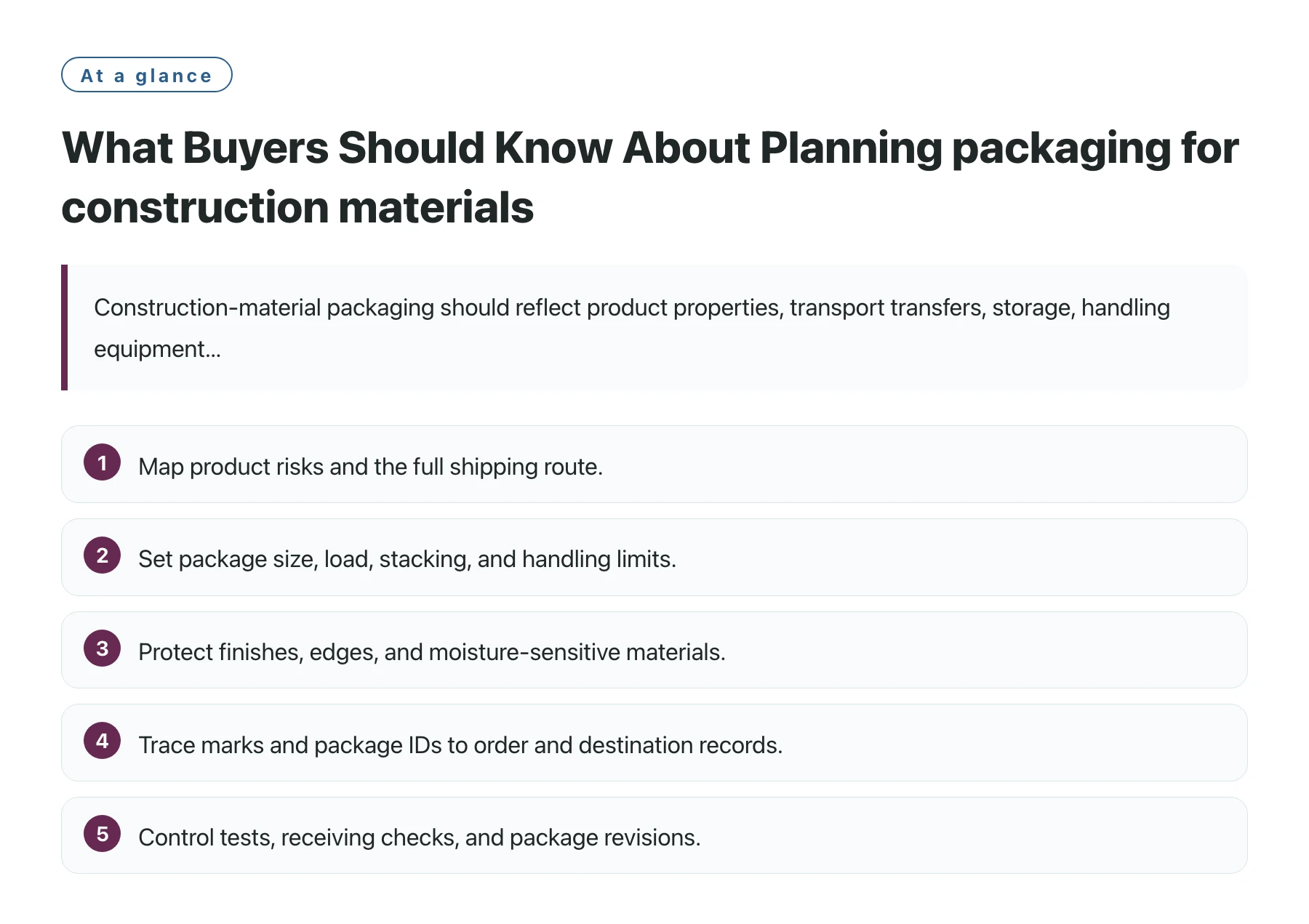
Construction-material packaging should reflect product properties, transport transfers, storage, handling equipment, and the receiving site. A clear package specification connects protection with labels, shipment data, and installation sequence.
Key takeaways
- Map product risks and the full shipping route.
- Set package size, load, stacking, and handling limits.
- Protect finishes, edges, and moisture-sensitive materials.
- Trace marks and package IDs to order and destination records.
- Control tests, receiving checks, and package revisions.
Good packaging prevents avoidable damage while keeping loads identifiable and practical to handle at every transfer point.
1. Start from the material and transport route
Construction materials may be dense, brittle, moisture-sensitive, sharp-edged, long, or dimensionally unstable. Describe the product, finish, weight, bundle or unit count, destination, handling equipment, transport mode, storage duration, and expected site conditions before choosing a package. A tile carton, glass crate, stone bundle, and metal profile need different protection and handling.
Map the route from factory packing through local haulage, port handling, ocean or air transit, customs, warehouse, and jobsite delivery. Identify transfers, outdoor exposure, stacking, and receiving limitations. Packaging should protect the product across the actual chain rather than only look adequate in a factory photograph.
2. Define unitization and load limits
Specify the unit of sale and shipment: piece, carton, bundle, crate, pallet, rack, or container. State maximum package weight, dimensions, stack height, pallet footprint, fork entry, lifting points, and whether units may be split. Confirm limits with the warehouse, carrier, and jobsite handling team.
For heavy or long materials, calculate how loads will be supported and restrained. Avoid designing a package that can be safely moved only by equipment unavailable at the destination. Request a packing drawing with loaded dimensions, center of gravity when relevant, and proposed lifting method for oversized or irregular goods.
3. Protect surfaces, edges, and moisture-sensitive goods
Identify likely damage modes: abrasion, impact, corner crush, bending, vibration, corrosion, water ingress, staining, or contact between finished faces. Specify separators, edge guards, protective film, desiccants, barriers, or blocking only where they suit the material and route. Check whether protection can leave residue or damage a finish during storage.
State the storage and environmental assumptions. Products exposed to rain at a jobsite may need a different barrier and inspection schedule from goods kept indoors. Ask the supplier to explain which surfaces remain vulnerable after unpacking and what receiving staff should inspect before moving the material.
4. Design for stacking, restraint, and handling
Define how cartons, bundles, or crates can be stacked and what load they must support. Provide direction, height, and restraint requirements. Ensure bands, straps, screws, and blocking do not compress, scratch, or deform the product. Ask the supplier for a packing test or evidence when a failure would affect a large shipment or expensive finish.
ISO 780:2015 specifies graphical symbols commonly used on distribution packages to convey handling and storage instructions. Use handling marks only when they communicate a necessary instruction, and confirm that the carrier, warehouse, and destination team understand the symbols. Marks do not replace suitable package design or dangerous-goods instructions. [1]
5. Make labels traceable to orders and locations
Agree carton or bundle marks for buyer, project, purchase order, product code, finish, dimensions, quantity, lot, sequence, gross weight, and destination. For phased construction projects, include building, floor, room, or installation zone when known. Keep label fields legible after strapping and pallet wrap.
Define barcode or QR format, language, label position, and data source if the receiving system uses scanning. Reconcile each package identifier to the packing list and order schedule. For mixed loads, use a clear map so installers can identify the correct material without breaking protective packaging unnecessarily.
6. Consider packing materials and disposal
Request a material list for cartons, timber, foam, film, metal frames, straps, and corner protection. Ask whether materials can be recycled or reused at the destination and whether treatment or marking requirements apply to wood packaging. Confirm any local waste-handling or project sustainability requirements with the buyer’s team.
Do not overpack by default. The package must provide adequate protection, but excess weight, volume, and disposal effort can add cost and complicate handling. Compare options using test results or a controlled pilot where appropriate, and keep the approved package specification with the product revision.
7. Plan inspection before and after packing
Decide which product checks must occur before the package is closed and which packing checks can be made from the outside. Define how representative packages are selected, how opened units are resealed, and who records substitutions or rework. Check both package construction and product identity.
At receipt, record visible damage before unloading or unpacking where practical. Define time limits, photographs, carrier notation, quarantine space, and contact route for claims. An outer carton that appears intact does not prove hidden surfaces are undamaged, so the receiving plan should state how and when unpacked materials are examined.
8. Confirm marks, documents, and shipment data
Match package marks and packing lists to the purchase order, invoice, booking, and destination instructions. Confirm who supplies package count, dimensions, weights, commodity description, and any handling notes to the freight provider. If loads are consolidated or split, record which identifiers belong to each shipment and destination.
Do not rely on generic symbols for regulatory declarations or special cargo instructions. Ask the buyer’s trade and logistics owner to confirm required documents, cargo handling, and any local obligations. Resolve differences between actual package measurements and quoted freight data before dispatch to reduce reweighing or storage surprises.
9. Test and control package changes
For a costly or fragile product, a trial pack, drop or vibration evaluation, compression check, or route simulation may be appropriate. Select methods and acceptance limits with qualified packaging or logistics specialists. Record product condition before and after, package revision, route assumptions, and any limitations of the trial.
Control changes to carton grade, pallet design, restraint, supplier, dimensions, and labels. A change that reduces volume may alter protection or stacking performance. Require written review and approval before the revised packaging is used for a live order. Keep samples or photos of the approved pack for production comparison.
10. Coordinate factory, carrier, and jobsite
Assign responsibility for package design, packing execution, inspection, freight data, unloading, storage, and disposal. Confirm equipment and labor available at each handoff. For oversized loads, schedule access, permits, lifting equipment, and receiving windows with the destination team before production completes.
Teams using JS Sourcing can bring suppliers, freight providers, and construction-site receivers onto one packaging brief. Confirm the actual product dimensions, protection criteria, marks, test evidence, and delivery sequence in writing, then reconcile the final packing list before shipment release.
Sources
Frequently asked questions
What information should a packaging brief include?
Include material properties, dimensions, weight, route, handling equipment, storage conditions, damage risks, package limits, marks, and receiving process.
Are handling symbols enough to protect construction materials?
No. Symbols communicate selected handling instructions; the package still needs design and testing suited to the material and route.
Should suppliers use the same packaging for every material?
No. Dense, brittle, long, finished, and moisture-sensitive materials have different support and protection needs.
How can I reduce damage claims at the destination?
Agree packing criteria, inspect representative units, record package IDs, and define receipt photographs and claim deadlines in advance.